Essays and Thoughts on the Arts, Culture, and the Digital Humanities by Scholar Richard L. Edwards
This paper started its life back in 2000 in a course taught by USC Art History professors Richard Meyer and Nancy Troy. The course was on the topic of the writing the history of Art, and it was a marvelous experience. This summer course met at the
Getty Research Institute, part of the Getty Museum campus in Los Angeles. You couldn’t ask for a better place to gather to think about or discuss art. At the time I had already begun writing my dissertation
New Media Activism: Alternative Media Collectives and New Technologies from Video to the Internet. I also was actively researching Guy Debord’s works as models and inspirations for media activists. I was particularly drawn to Debord’s pre-
Society of the Spectacle artworks and his collaboration with Danish artist Asger Jorn. But the book,
Mémoires, like Paul Strand’s “House and Billboard,” drew my attention the most.
I am reprinting a revised version of that paper here for a couple of reasons. First, I find Debord’s work completely irresistible and utterly challenging, but also not as prominent as I would expect it to be in new media or digital media studies. Part of that problem, which I address in this paper, is that Debord’s work tends to get coded (and worse, dismissed) as “Situationist” and political (which it is), leading towards the neglect of its artistic legacy and its creative potential.
Critic Greil Marcus has done a great job of showing Debord’s “lipstick traces” on the punk movement, but I would like to see more about Debord’s influence on the digital age, especially as one of the key figures impacting digital remix culture. In terms of progenitors of remix culture, I believe Debord’s art practices (he was an early multimedia artist) should be considered alongside the
“cut-up” technique of William Burrough and artist Brion Gysin.
Second, this paper lays out my preference for a certain approach to analyzing complex artworks, whether a photograph, a book, a painting, or a film noir. I favor an analytical frame that focuses on a close reading of the work at hand and which minimizes one’s reliance on historical, biographical or theoretical frameworks. However, that is not the same as saying I am dismissing those other important frameworks. Rather I have found it useful in my own scholarship to rely on my own close reading of a work, for reasons that hopefully become clear in the essay below. A similar analytical approach is on display in my recent Paul Strand talk and perhaps more so in
my long-running podcast series with Shannon Clute, where we perform close readings on films in the noir tradition.
Third, I want to expand discussions around
Mémoires. It is a very complex and polyvalent work, but many people are only familiar with the book’s famous cover “gag.” The original book cover was made of sandpaper. Of course, a sandpaper cover has the effect of making the book literally “abrasive” when shelving it next to other books, and it can “scratch” a nice table. But I am more interested in what Debord and Jorn are up to under the cover.
Uneasy Arrangements: Looking at Guy Debord’s Mémoires
1.
let no one claim I have nothing new to say: the arrangement of materials is new
—From
Mémoires[1]
One is never at ease before the works of Debord
—Asger Jorn
[2]

Image found online at http://www.interencheres.com
You get the idea. You locate a copy of the book you want to analyze. You find it at the Getty Library, and you will write your description of the book based on your first hand experience, since until now you have seen only pieces of it: here and there a fragment appearing as an illustration in an article or an occasional color frame in a museum catalogue. And even though it will be hard to do, you will try to put aside what you know about the book from your readings. You want to write an extended description of the book based on your insights and your observations. Moreover, you will try not to think about having to view it in the Special Collections room at the Getty Library, since something seems wrong about looking at it in such a space—a betrayal of the book’s original intentions or perhaps something more banal: that this book had better be “special” after all the hoops (appointments and handwashing, to name just two) you have to go through to look at it. On the other hand, you are anxiously waiting for the book in all its archival glory and rarity. You are hoping for a glimpse at the original Pormild and Rosengreen edition, published in Copenhagen in 1959. You know that there are only about one thousand copies of this edition in existence, maybe less. You want to run your fingers over its cover made of sandpaper,
[3] see the potency of its use of color, and hold it in your hands to gauge its original size of 27.5 by 21.5 cm. And you are disappointed when you are given a 1977 reproduction of the book, the Phosphore edition.
[4] While you are glad to be able to see the book in its entirety, many aspects of the original edition are missing. The Phosphore edition contains a soft cardboard cover with a curious drawing,
[5] the reproductions are often badly executed (resulting in unintentionally missing words or images) and finally, the whole edition is reproduced in faded blacks and whites. Now you worry that in attempting to describe this book, you will have to somehow imagine the book in front of you through your memory of full color reproductions or determine the meaning of some barely legible image from the readings you have done. Far from being able to put aside what you know about this book, you seem relieved to know something about it beforehand. You find some comfort in being able to mentally fill in some of the gaps in the Phosphore edition. You let your memory serve as a kind of map as you peruse the book. You sometimes find the book’s play of words and graphics conforming to the Lettrist International notions of
dérive and
détournement.
[6] Other times, the book seems a willfully obscurantic text and not at all what you were expecting. You are on a slippery slope and feeling uncomfortable. This book poses multiple problems of description: original versus reproduction, black and white versus color, theory versus practice, as well as complicated issues relating to art, history, language, commodity culture, politics, etc. Somehow as you reach the end, the last words of the book come alive, revive themselves as challenge, threat and limit on your ability to describe this work: “
je voulais parler la belle langue de mon siécle. (I wanted to speak the beautiful language of my times.)”
[7] You get the idea.
2.
…turning a page is like waking from a dream, or falling into one.
—Greil Marcus discussing
Mémoires

Image found online at wikipedia.org
, by Guy Debord with Asger Jorn, is a difficult visual object to describe. Besides the issue of two different published editions,
[8] the book itself is a long work of approximately fifty pages.
[9] Each of its fifty pages is different. As the book proceeds (literally in the sense of moving from the front cover to the back cover), different visual and textual approaches are undertaken. The book’s breadth of artistic and literary invention seemingly confounds any attempt to reduce the work to a single page or even cluster of pages. Moreover,
Mémoires is intentionally perplexing and vexing with wordplay and graphic touches that complicate linear thinking and fight against totalizing meanings. Finally, history itself poses difficulties for the description of this work. One of the few things most everyone agrees on about the book is that it is clearly divided into three different sections: June 1952, December 1952 and September 1953. These three dates coincide with the initial years of Debord’s involvement in the Lettrist International (LI). As such, in many critical accounts of this work,
Mémoires is seen through a biographical, or at least a historical, lens that helps situate this work in a cherished position as both an archive of early Situationist thought and as a privileged instantiation of Lettrist and Situationist theory.

Image found online at http://www.virose.pt/vector/b_13/nolle.html
Before I analyze what problems of description other critics have encountered with this work, I want to discuss my own difficulties in describing it. I try to minimize theoretical or historical models in attempting to describe the page. I do not want to dismiss the necessity of seeing this page and/or book within other discourses such as the history of the Situationist International or the careers of Debord and Jorn. Rather I want to return to an object that is often “lost” when analyzed solely through these discourses. It is possible to get a skewed view of the book if you only know it through written sources or a few illustrations. The sheer polysemy of
Mémoires gives it a certain feeling of being both about everything and nothing. The problem is that any particular page of this work can lead toward the impression of a Rorschach test: the beholder (or reader) may see (or read) what he or she wants.
[10] This leads to methodological problems surrounding the book often given short shrift in the critical literature about Debord, Jorn and
Mémoires. What is the relationship of text and image? Can you discuss the meaning of a particular piece of text outside its relationship to the page and the book as a whole? What precisely is the nature of this object—should it be understood as a book? A collage? A painting? A lithographic reproduction? Is this book art or an instance of social activism? Is the meaning of
Mémoires to be found through formal art-historical techniques, for example the precise description of image/text relations and the book’s use of color, shape, line, etc that I focused on? Or is the meaning of the book located in a strategy of reading (a
dérive of reading) and a reaction to Debord and Jorn’s collages (a
détournement of viewing)? Or some combination of all of these approaches?
To begin to answer these questions, I need to discuss some of the difficulties I have in describing
Mémoires. There are four important issues I wish to foreground that both constrain and construct my description of this work: the collage aesthetic, the transformative context of the book, the use of repetition and variation, and the problems surrounding the book’s use of language.
No single page can make a claim as being representative of the overall project. Each page is a complex collage of prefabricated elements. But the difference between each individual page needs to be understood in relation to the overall text and the organizing formal logic of each page, as well as the book itself, is a collage aesthetic. When looked at serially throughout the course of the book, the accumulation of the various collage pages creates a type of visual rhythm.
[11] The rhythm, similar to the editing of a movie, is concocted through matching (and indeed, mismatching) elements of color, shape, texture, and size, as if pages in
Mémoires could exist as frames in a motion picture. Independent of the words on any given page, the artistic construction of each page frequently recalls the brush strokes and use of paint in the Abstract Expressionist movement, such as the work of Jackson Pollock. The collage aesthetic also helps structure the book’s use of language. For example, some of the phrases that occupy any particular page may be understood as a type of fragmentary sound collage one would hear standing for a time on a Parisian street or sitting in a lecture hall.
Second,
Mémoires is a book whose meanings on any particular page change as it is read over and over. This makes sense since the overall context for any single page is the total framework of the book. For example, when I first read the book, it appeared as if there was possibly a progression from simpler forms to more complex forms. But upon a second reading, I recognized that this was not so. What I read as “complexity” was the insertion of different graphic elements (cartoons and photographs, e.g.) which made the earlier paint-and-text-only combinations seem simple. But that dismisses the complexity of the word/image relations of the earliest pages of the book. Another context is the role of maps and mapping functions in the book. Early in the book, one might not read the painted lines as lines in a map. But after finishing the book, it is almost impossible not to. Towards the end of the book, actual maps of cities become inserted and due to their graphic similarity to Jorn’s painted lines, force us to recognize that a mapping function is part of the book’s graphic design.
[12]

Comparison of two pages in Memoires (right side is the original; left side is reprint) From http://www.virose.pt/vector/b_13/nolle.html
Third, an analysis of a single page of
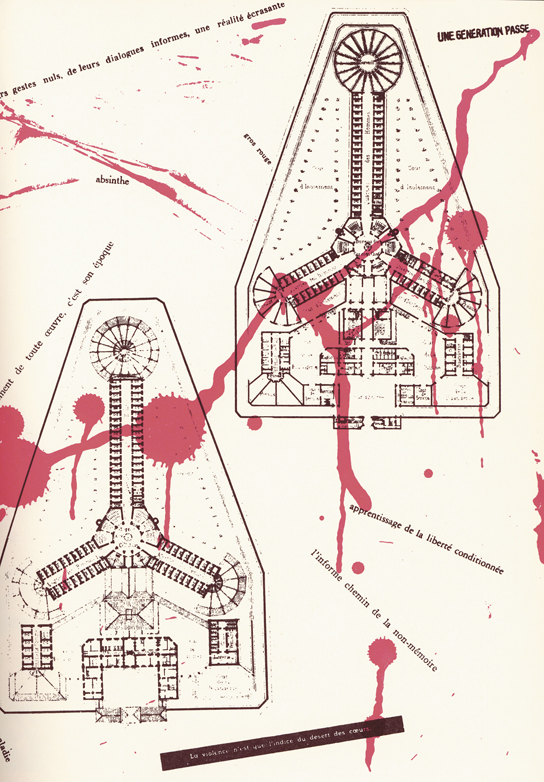
Mémoires cannot account for the importance of repetition and variation. For example, in the first section (June 1952), the name “Barbara” crops up on many pages. The appearance of the name reminds one of its previous presence, and helps connect various pages together. Diagrams of a prison floor plan surface throughout the second section (December 1952). There are multiple city maps used in the third section. Another good example of repetition and variation is Asger Jorn’s painted lines that flow throughout the work. Early in the book, the lines tend to connect words together. In later sections, the paint can cut across images or even imprison an image. On one page in the third section, there are illustrations of villages and towns.

Image found online at http://www.artlies.org/article.php?id=1623&issue=58&s=
However, the paint crisscrosses the image, creating a sense of prison bars and confinement. This type of variation in the paint strokes links up with the repetition of prison images in the second section. Like notes in a symphony, these repetitions and variations help give the book a lyricism that unites particular themes and ideas. The repetitions and variations help unify the work formally without demanding a singular meaning or theme be attached to any one instance of repetition or variation. In this sense, the repetitions and variations create a tone or mood for the overall book more than generate a determinate meaning or theme.
Finally, the status of the words and text blocks that appear on each page is problematic. How should we discuss the use of words in this book? For one thing, in places the words themselves become images, as when Debord crumples them up into graphic objects. For another, as meanings in their own right, do we accept the words as “literal” and attempt to account for them in the overall meaning of the book—as parts of an overarching discourse? Or are the words an instance of “detournement” and perhaps we should only remark upon their randomness, their new context and possibly their ephemeral quality. It is impossible to ascertain the answer definitively, since the answer lies somewhere between the two positions. But most critics have seemed comfortable taking the words out their original context and quoting them.
[13] One way to contain the unruliness of this book’s language is (paradoxically) to read it through the increasingly structured discourse of contemporary Situationist theory and practice. And perhaps this is inevitable in a work that at some level is a Situationist project. The problem is that it becomes increasingly difficult to separate our own historical and theoretical understanding of the Situationist movement with an object that has a particular materiality and unique conditions of production.
My preferred method was to look at each single page, as standalone works, to determine if there was something that I was missing by already approaching the work for a particular theoretical or historical construct. Surprisingly, after I finished my analysis, I felt that I truly had looked
at the object versus looking
for an object. In the precision of a page-by-page analysis, I uncovered elements of its formal composition I had previously missed, especially the significance of how items were placed and how that created particular viewing effects that I describe metaphorically (floating, rays of light, etc.) Second, it recovered something else that was essential: a pleasure in looking. Why has this object attracted so much attention over the years? After wiping away the sedimentation of theory, the object itself has a beauty and an artistic intelligence that is riveting. Moreover, the politics of the Situationist International may be in part wrapped up in this type of pleasure—perhaps fetishizing this object in a politics of pleasure.
3.
has everything been said?
—From
Mémoires [14]

Image found online at http://www.virose.pt/vector/b_13/nolle.html
The problem of description for
Mémoires also needs to address published accounts as well. The subsequent reputation of Guy Debord has complicated descriptions of
Mémoires. Debord became the renowned author of
Society of the Spectacle. His stature grew after the events in Paris of May ’68, and he is also known for his work as a filmmaker. However, part of it has also do to with the Debord’s status within the Situationist International. He became that group’s best known member and
Mémoires, in Greil Marcus’ words, is a “Situationist primer.”
[15] Importantly, we can examine two descriptions of
Mémoires and attempt to assess how these descriptions have constructed (and constrained) the object.
One of the earliest descriptions of the work was in fact by Asger Jorn. In his preface to Debord’s book
Contre le Cinema (1964), Jorn describes
Mémoires in glowing terms (Jorn collaborated on
Mémoires as well, so we should take his words with some circumspection)
[16]:
Thus the moment was ripe for our hero [Debord] to write his
Mémoires, which was done with the grating effect of broken glass – a book of love bound in sandpaper, which destroys your pocket as well as entire shelves in your library, a nice reminder of the time past that refuses to end and distresses everyone with its obstinate presence.
[17]
Importantly here, two ideas are summoned by Jorn that have more or less appeared as parts of other critical accounts: Debord as “hero”
[18] and the lack of a formal analysis of the work itself. Jorn’s assessment of the book is fairly typical: the book as an artistic “success.” In other words, part of the problem of writing about
Mémoires is the consideration that the book might fail to live up to these expectations. Alternatively, perhaps too much is read into this book in light of Debord and Jorn’s subsequent successful careers. Indeed, the book is readily deployed in many essays as if it may be a “perfect text.” The sandpaper cover is a good example of this phenomenon. While the sandpaper cover forces you to recognize that this book might literally have a “grating” quality, it is unlikely that it would destroy “entire shelves in your library.” But it is precisely that type of desire and utopian optimism that imbues descriptions of this book.
Greil Marcus’ description is probably among one of the most widely known. His description appeared in the museum catalogue for the 1989 exhibition of Situationist art works: “On the Passage of a few people through a rather brief moment in time: The Situationist International 1957-1972.”
[19] Marcus’ descriptions of
Mémoires are very celebratory. A brief sampling of comments from his essay include:
Mémoires affirms that everything needed to say whatever one might want to say is already present, accessible to everyone; the book defines a project, and tells a story. (page 126)
…the book feels like a drunken sprawl through the encyclopedia of common knowledge. (page 127)
Mémoires is about the sense that along with the struggle to change the world, to make or find a new civilization, comes the conviction that one will fail those hopes, that the true struggle will be to remember what, once, one meant to do. (page 128)
A recurring idea throughout Marcus’ analysis is that
Mémoires tells a story. This has to do partially with the common idea that
Mémoires, on one level, is a history of the Lettrist and Situationist movement. But I am not sure what story is being told (at least not in a standard narratological sense). Second, I feel that Marcus reads the book through the lens of Situationist theory and practice. As such, I am not sure if
Mémoires supports the theory or the theory supports the book. Moreover, there are no critiques of the book offered by Marcus and most of his writing about
Mémoires does not contain close formal analysis. When he does discuss particular pages, it is usually in general terms and then in conjunction with biographical or historical information. Finally, there seems to be no attempt on Marcus’ part to analyze how the book as a whole has been constructed as a visual (art) object. Again, this is not necessarily his goal, but Marcus’ essay does demonstrate the difficulty of describing this text and how intertwined interpretations of this text have become with Situationist theory and practice.
4.
fin
In terms of my broader project regarding the role of new technologies and alternative media, I have always seen
Mémoires as a prefigurative model for a particular type of communication. If we remove the accumulated layers of Situationist theory, the description of
Mémoires that I forward in this essay can be aligned with issues that influenced Web 1.0 (hypertext) and the remix aesthetics and social media of Web 2.0.
Mémoires, in this sense, explores issues of how communication, political economy and desire will become increasingly interconnected through networks. It also warns about the danger of the commercialization of information, and the transformation of personal information into mere data. The network becomes the mode of communication and connection central to
Mémoires. Debord’s notions of the
derive and
detournement, first explored on the city streets of Paris, can now find new and unexpected uses in the digital pathways of the remix and the mashup.
[1] Translation from Marcus, p. 125.
[3] Greil Marcus comments about its sandpaper cover: “…bound in heavy sandpaper,
Mémoires pretended that, when placed in a bookshelf, it would destroy other books…” See Marcus, Greil. “Guy Debord’s Mémoires: A Situationist Primer,” in
On the Passage of a few people in a rather brief moment in time: The Situationist International 1957-1972. Ed. by Sussman, Elisabeth. (The MIT Press: Cambridge, MA, 1989), p. 130.
[4] See Debord, Guy.
Memoirs: structures portantes d’asger jorn. Editions du Phosphore, Paris, France, 1977.
[5] For no discernable reason, the Phosphore edition has a large pencil sketch of a male figure on the right hand side of the cover. This inclusion of the male figure becomes all the more puzzling in light of the original cover of the Pormild and Rosengreen edition, which simply gives the name of the two authors, the title of the work in simple block letters, and a line in French translated as “composed entirely of prefabricated elements.”
[6] Greil Marcus’ definitions of derive and detournement are among the best and most succinct I have seen: “Detournement (literally ‘diversion,’ with connotations of criminality and delinquency) meant the theft of aesthetic artifacts from the Old World and their revitalization in contexts of one’s own devising…The derive (literally, ‘drift’ in the nautical sense) was a matter of opening one’s consciousness to the (so to speak) unconsciousness of urban space; the derive meant a solo or collective passage down city streets, a surrender to and then pursuits of alleys of attraction, boulevards of repulsion, until the city itself became a field of what the LI called “psychogeography,” where every building, route, and decoration expanded with meaning or disappeared for the lack of it…” (p. 127).
[7] The last line of
Mémoires is translated in Greil Marcus’s article as “I wanted to speak the beautiful language of my time.” Marcus, p. 125
[8] Please note that this does not preclude the possibility of even more published editions of Mémoires. My research indicates that there is a third edition (by a different publisher) of Mémoires in the 1990s, but I was unable to locate a copy of this edition to verify what changes or differences it may have.
[9] The problem of page length and the problem of identifying specific pages in this book are complicated by the lack of pagination in the work. In most published accounts, there has not been an attempt to give the book a definitive length. Most critics appear to favor to describe its length with a certain indeterminacy. For example, Claire Gilman refers to the work as “approximately fifty pages long.” Gilman, Claire. “Asger Jorn’s Avant-Garde Archives,”
October 79, Winter 1997, p. 43.
[10] As an aside, the allusion to a Rorschach test might apply to my experience of the 1977 Phosphore edition. On several pages instead of the vibrant colors intended in the Rosmild and Rosengreen edition, the Phosphore edition renders the graphic elements as blotches of black ink. I saw a distinct parallel in the abstractions of Debord and Jorn to the purpose of a Rorschach test, that is made more concrete with the desaturated and faded black and white hues of the Phosphore reproduction.
[11] While Greil Marcus uses the word “rhythm” in his essay to describe the work, I feel I am using the word in a slightly more formal way than Marcus is. For example, Marcus states: “The rhythm of
Mémoires becomes one of isolation to contact, contact to community, community to broken contacts, broken contacts to isolation.” See Marcus, page 131. This footnote also highlights my sensitivity to published accounts of the work that are continually playing in my head as I write this account.
[12] In light of Svetlana Alper’s analysis of the mapping impulse in Dutch art it seems interesting to me that two of Debord’s books,
Fin de Copenhague and
Mémoires were published in Copenhagen. Moreover, Craig Sadler in his book,
The Situationist City, makes explicit connections between maps and Situationist theory in Debord’s art, which is not surprising given the Situationist’s interest in the
dérive and psychogeography.
[13] See Marcus, p. 125. Greil Marcus lists several phrases that he lifts from different places in the book with no apparent concern for their contextualization (or decontextualization). There is no attempt, as far I can discern, to initiate a project similar to Marcel Duchamps’
Green Box, whereby a typotranslation (in some sense a guide to a text that is difficult to obtain) is attempting to abide with certain types of word/image relations found in the original object.
[14] Translation from Marcus, p. 125.
[16] Also, we have to take its publication context into account since he was writing a preface to a book for Debord. However, the important point is not Jorn’s positive assessment of the book, as much as how that positive assessment seems axiomatic for this work and how later critics accept Jorn’s views. For example, Greil Marcus quotes Jorn as support for his own arguments.
[17] Jorn, “Preface to Guy Debord’s
Contre le Cinema,” no page number.
[18] For example, see the following quote from Marcus: “…the book has its own voice: the voice of romantic, heroic, questing, dissipated, reflective, melodramatic, even schoolboy adventure.” (p. 126)
[19] The exhibition was shown, on a rotating basis, at the Centre George Pompidou in Paris, the Institute of Contemporary Arts in London and the Institute of Contemporary Art in Boston, MA.